
Author: T. Włostowski
-
White Rabbit Applications and Enhancements
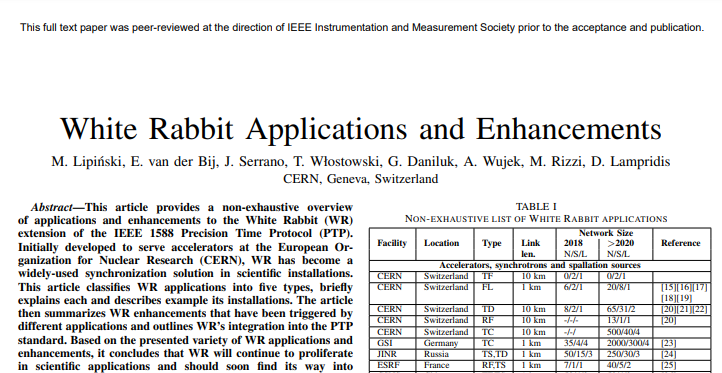
Abstract This article provides a non-exhaustive overview of applications and enhancements to the White Rabbit (WR) extension of the IEEE 1588 Precision Time Protocol (PTP). Initially developed to serve accelerators at the European Or-ganization for Nuclear Research (CERN), WR has become a widely-used synchronization solution in scientific installations. This article classifies WR applications into five
-

THE WHITE RABBIT PROJECT
Abstract White Rabbit (WR) is a multi-laboratory, multicompany collaboration for the development of a new Ethernet-based technology which ensures sub-nanosecond synchronisation and deterministic data transfer. The project uses an open source paradigm for the development of its hardware, gateware and software components. This article provides an introduction to the technical choices and an explanation of
-
Reliability in a White Rabbit Network
Abstract White Rabbit (WR) is a time-deterministic, low-latency Ethernet-based network which enables transparent, subns accuracy timing distribution. It is being developed to replace the General Machine Timing (GMT) system currently used at CERN and will become the foundation for the control system of the Facility for Antiproton and Ion Research (FAIR) at GSI. High reliability
-
White Rabbit: a PTP Application for Robust Sub-nanosecond Synchronization
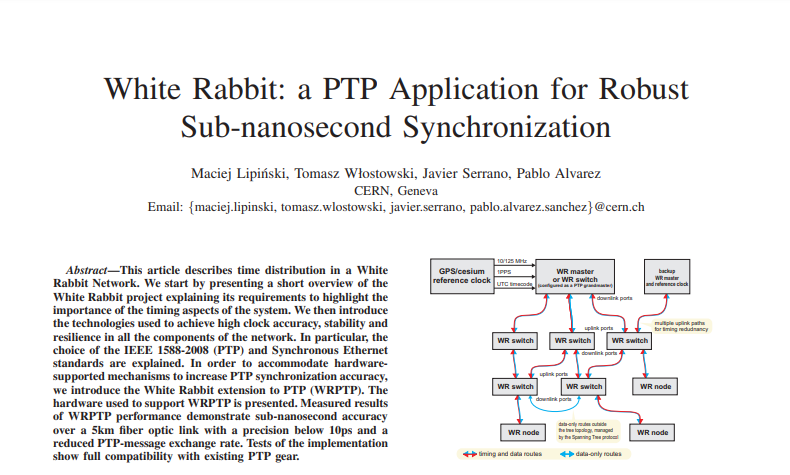
Abstract This article describes time distribution in a White Rabbit Network. We start by presenting a short overview of the White Rabbit project explaining its requirements to highlight the importance of the timing aspects of the system. We then introduce the technologies used to achieve high clock accuracy, stability and resilience in all the components
-
White Rabbit: Sub-Nanosecond Timing Distribution over Ethernet
Abstract White Rabbit (WR) is the project name for a ambiguous project that uses Ethernet as both, deterministic (synchronous) data transfer and timing network. The presented design aims for a general purpose, fieldbus like transmission system, which provides deterministic data and timing to approximately 1000 timing stations. The main advantage over conventional systems is the