
Category: Documentation
-
WRS v6.1 user manual
Authors: J-C. Bau, G. Daniluk, M. Lipinski, B. Rat, A. Rubini, F. Vaga, A. Wujek Abstract: The White Rabbit switch (or wrs) is a major component of the White Rabbit (wr) network. Like any modern managed switch, the wrs includes a CPU with its own operating system. This manual is for people installing wrs devices,
-

WR PTP Core user manuals
Overview Procedure and tools for calibrating the White Rabbit Switch (WRS) timing system. Latest version: v2.0 Updated: v5.0 – Released: Features added in this releae are listed in the release page. Downloads Past Releases v4.2 – 19 December 2017 Features added in this releae are listed in the release page. Downloads v4.1 – October 2024 Features added
-
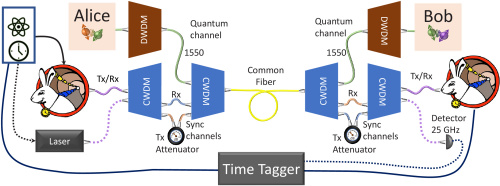
Synchronization and Coexistence in Quantum Networks
Abstract We investigate the coexistence of clock synchronization protocols with quantum signals in a common single-mode optical fiber. By measuring optical noise between 1500 nm to 1620 nm we demonstrate a potential for up to 100 quantum, 100 GHz wide channels coexisting with the classical synchronization signals. Both “White Rabbit” and pulsed laser-based synchronization protocols were
-
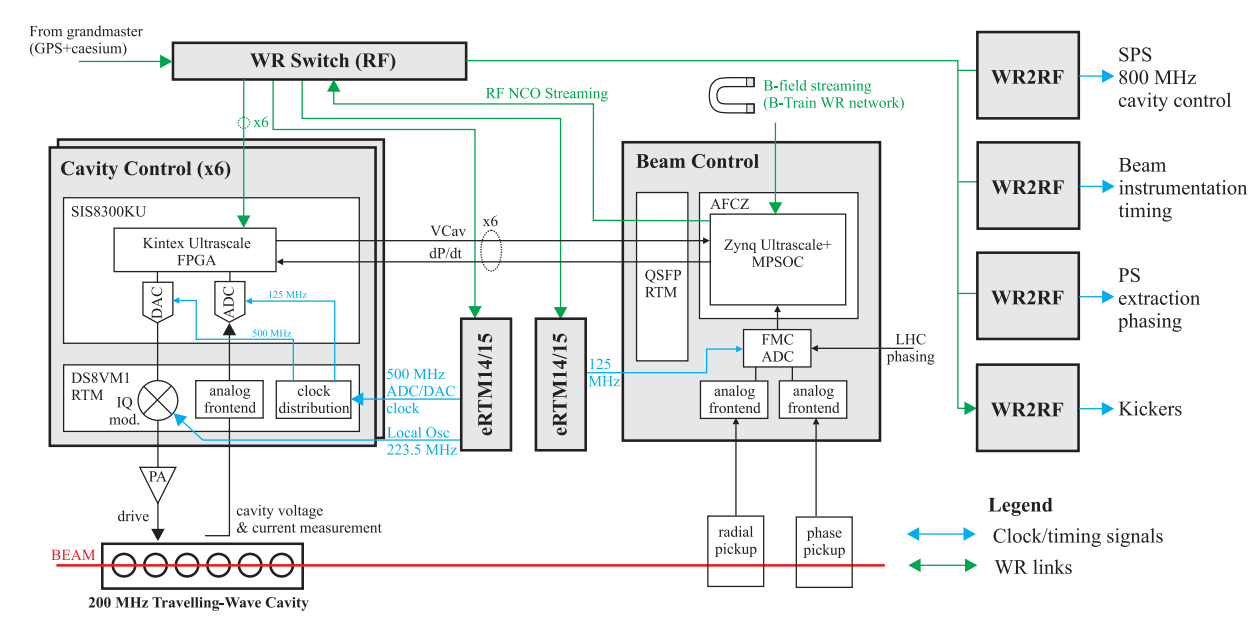
White Rabbit and MTCA.4 use in the LLRF upgrade for CERN’s SPS
Abstract The Super Proton Synchrotron (SPS) Low-level RF (LLRF) system at CERN was completely revamped in 2020 [1]. In the old system, the digital signal processing was clocked by a submultiple of the RF. The new system uses a fixed-frequency clock derived from White Rabbit (WR) [2]. This triggered the development of an eRTM module
-
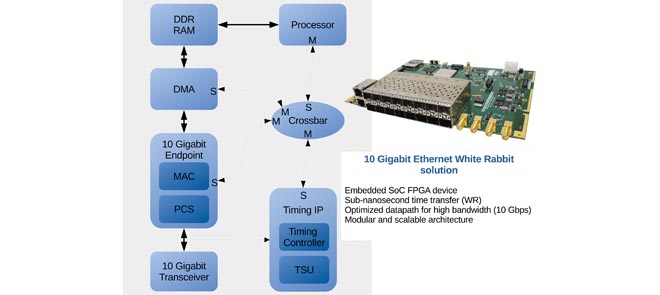
10 Gigabit White Rabbit: Sub-Nanosecond Timing and Data Distribution
Abstract Time synchronization is a critical feature for many scientific facilities and industrial infrastructures. The required performance is progressively increasing everyday, for instance, few tens of nanoseconds for Fifth Generation (5G) networks or sub-nanosecond accuracy on next family of particle accelerators and astrophysics telescopes. Due to this exigent accuracy, many applications require specific timing dedicated
-
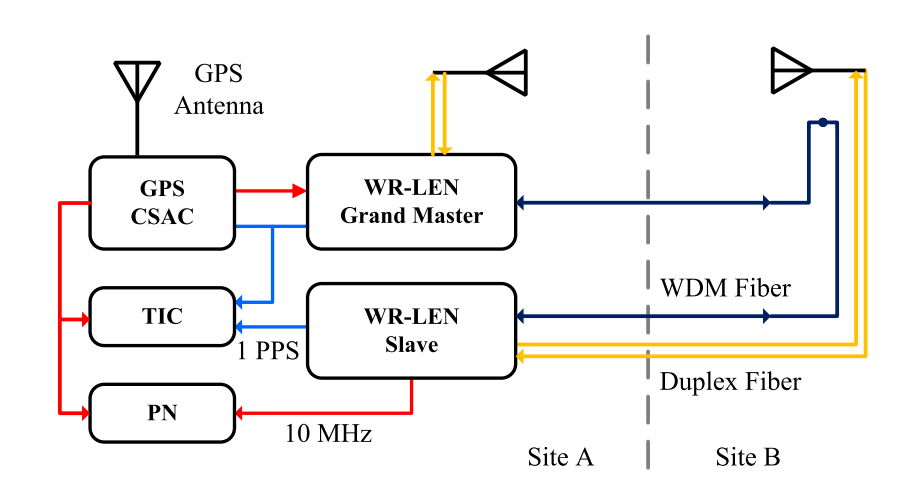
White Rabbit Time and Frequency Transfer Over Wireless Millimeter-Wave Carriers
Abstract We demonstrate time and frequency transfer using a White Rabbit (WR) time transfer system over millimeter-wave (mm-wave) 71-76 GHz carriers. To validate the performance of our system, we present overlapping Allan deviation (ADEV), time deviation (TDEV), and phase statistics. Over mm-wave carriers, we report an ADEV of 7.1×10⁻¹²at 1 s and a TDEV of
-
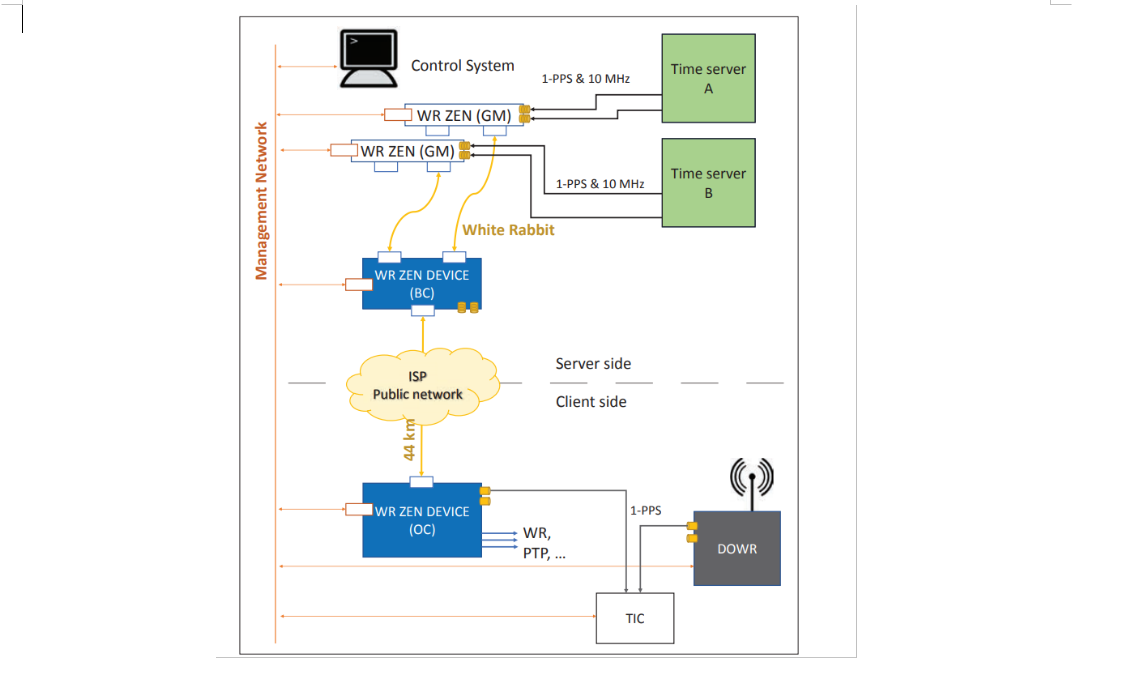
Time as a Service Based on White Rabbit for Finance Applications
Abstract The finance industry is being pushed by regulation to register most of its operations with timestamps legally traceable to a Coordinated Universal Time reference with up to 1 ms error. This poses a challenge for the sector, since the most commonly used solutions to provide time in the industry might not comply with the
-
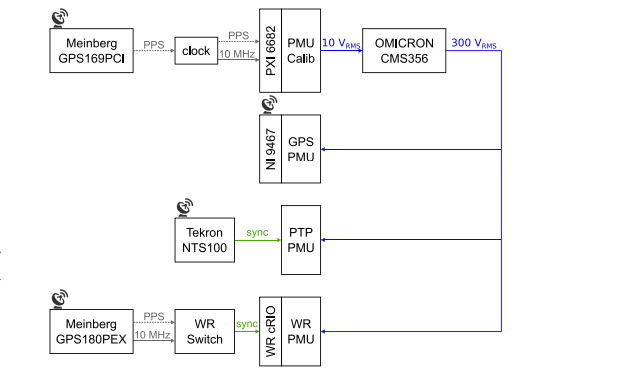
The White Rabbit Time Synchronization Protocol for Synchrophasor Networks
Abstract Within the context of time dissemination techniques for power systems applications, this paper discusses the use of the white rabbit (WR) protocol for synchrophasor networks. Specifically, this paper presents a phasor measurement unit (PMU) integrating the WR technology and its experimental validation with a focus on the synchrophasor phase estimation in steady state conditions,
-
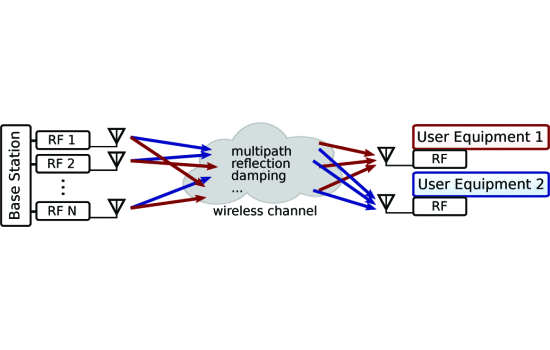
High Accuracy Synchronization for Distributed Massive MIMO using White Rabbit
Abstract Accurate synchronization is a crucial prerequisite for wireless communication systems and in particular for spatially distributed massive multiple-input multiple-output (MIMO) systems which is also used in the upcoming 5G mobile communication standard. Many applications based on MIMO transmission, such as communication systems or beamforming methods, require synchronization accuracy in the low sub-nanosecond range which
-
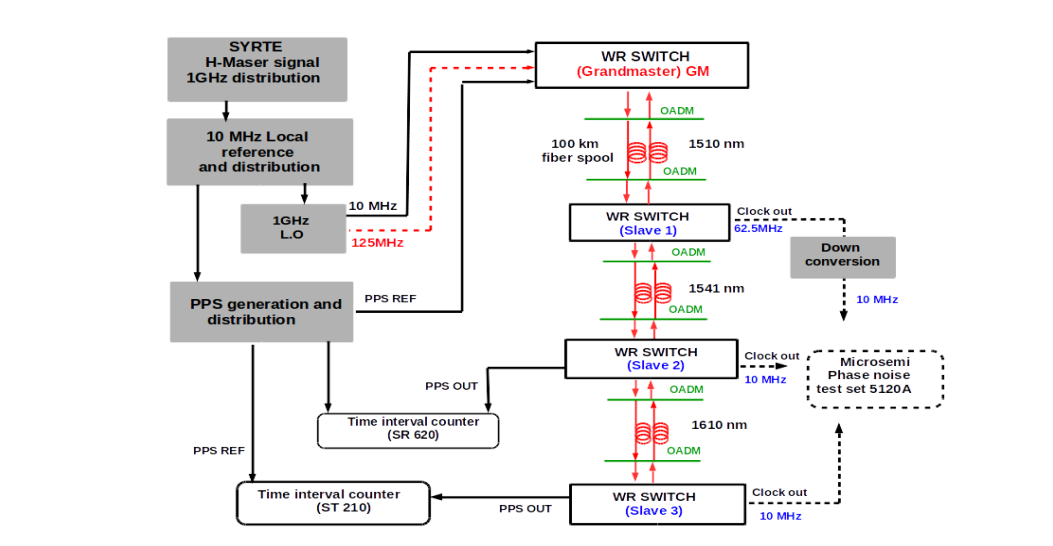
Long range time transfer using optical fiber links and cross comparison with satellite based methods
Abstract In this thesis our objective is to develop a scalable network time and frequency transfer approach, providing multi-user dissemination, compatible with large telecommunication networks and competitive with GNSS-based time distribution.Therefore we are concerned with methods for use in packet-based networks, like the Network Time Protocol (NTP) and Precision Timing Protocol (PTP). We also concentrate