
Collaboration Bureau to add a much-needed delay monitoring feature to switch firmware
The new feature can significantly simplify monitoring of redundant links or multiple time sources, enabling the collection of time offset data across distributed White Rabbit networks, as well as reduce the equipment needed for calibration.

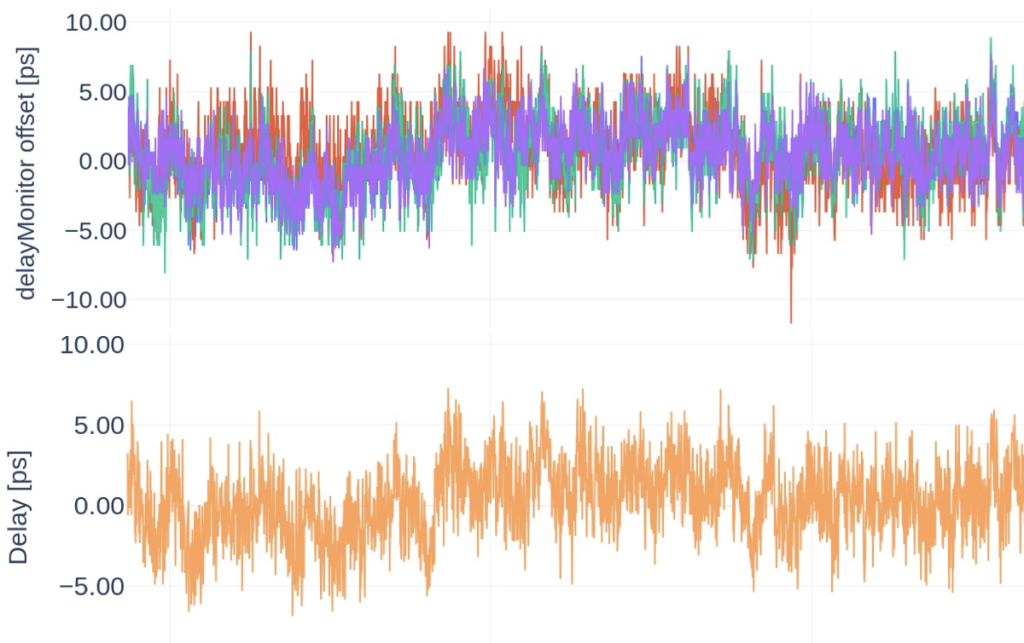
The White Rabbit Collaboration (WRC) Bureau is working on a new version of the open-source firmware which will include a delay-monitoring feature. This feature allows measuring the time offset between WR switches on each link with picosecond precision. Up to now, WR switches would only measure and correct for such an offset on one port (slave), which was connected to the WR switch higher in the timing hierarchy. The new feature can significantly simplify monitoring of redundant links or multiple time sources, enabling the collection of time offset data across distributed White Rabbit-based networks, as well as reduce the equipment needed for calibration. This allows users to collect, view, and archive time-offset measurements from compatible White Rabbit-based time sources through a single operational interface.
The basis for this feature was developed by VU Amsterdam. A substantial effort is underway by the WRC Bureau, as part of the WRC Development Plan, to mainstream this feature such that it is included in the next official open-source WR Switch firmware.
SURF, a member of the WR Collaboration, evaluated this new feature before the official firmware release, ensuring it is thoroughly tested in operational conditions and meets the needs of the most demanding users.
“SURF connected in Hamburg through NORDUnet to the Nordic Timing Pilot run together with the Nordic NRENs and NMIs in a cross-border field trial. The WR switches (already incorporating a beta release of the new firmware) were used to collect time offset data for a comparison between the time scales of VSL, the National Metrology Institute of the Netherlands, and RISE, the Swedish National Metrology Institute. The installation used several hundred kilometres of existing fibre-optic infrastructure and demonstrated the practical use of the new feature for timing comparisons.”
This trial proved that by using the new feature, the need for dedicated, site-specific, expensive measurement equipment is reduced. The new firmware can lower the cost by several tens of thousands of euros per measurement point and reduce the complexity of multi-institution timing experiments. Operators can start measurements from a central console, monitor in real-time the timing offset, and archive collected results for later analysis.
“This new feature makes high-precision timing measurements easier and cheaper to do. One no longer needs a WR switch and an expensive oscilloscope for each measurement point, allowing to save tens of thousands of euros!” said Adam Wujek, member of the WRC Bureau.
“The Hamburg field trial shows how open-source White Rabbit technology can support collaborative timing experiments over existing fibre infrastructure,” said Paul Klop, a SURF Network Architect.
This new feature, to be included in the next WR Switch firmware release, reflects the continued cooperation between the White Rabbit Bureau and the members of the WRC to improve open, interoperable timing technology for a variety of scientific and industrial applications.
For more information, contact the White Rabbit Collaboration at bureau@white-rabbit.tech
The new release will be available to download in the coming months from: www.white-rabbit.tech
