Category: Documentation

  • Temperature Effect on White Rabbit Timing Link

    Temperature Effect on White Rabbit Timing Link

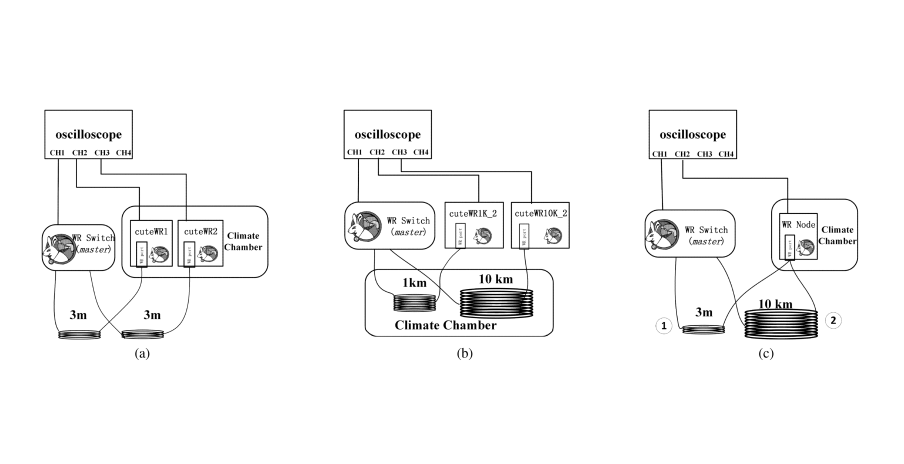
    Abstract White Rabbit (WR) technology combines gigabit Ethernet data transfer with synchronization at subnanosecond accuracy and picoseconds precision over the same fiber medium. In some applications, the WR link must maintain the synchronization accuracy over a wide temperature range. The temperature effect on a WR link is measured, and contributions from different components like optical

    Explore →

  • White Rabbit: When Every Nanosecond Counts

    Abstract A highly accurate Ethernet-based timing solution is making its way to market in products built around Xilinx FPGA and SoC devices. MORE ABOUT THIS TOPIC Related Publications Are you looking for a paper in particular?

    Explore →

  • White Rabbit Applications for FAIR Experiments

    Abstract A White Rabbit (WR) based timing system will be used at FAIR as a field bus for accelerator controls. In addition WR Timing Receivers (WRTR) are required by FAIR experiments for the synchronizaton of independent detector sub-systems. For this purpose hardware latching of time stamps on WRTR has been implemented. A test bed has

    Explore →

  • PPSi – A Free Software PTP Implementation

    Abstract This paper describes a new open source implementation of the Precision Time Protocol (PTP) [1] called PTP Ported To Silicon (PPSi) [2]. It was developed to fill in a niche in the free software world for a PTP daemon that is easily portable to a wide range of architectures and highly modular to enable

    Explore →

  • White Rabbit calibration procedure

    Abstract This document describes the calibration procedure for White Rabbit devices. MORE ABOUT THIS TOPIC Related Publications Are you looking for a paper in particular?

    Explore →

  • Paving the Way for the FAIR General Machine Timing System

    Abstract The task of the General Machine Timing system (GMT) is the hard real-time control of the GSI and FAIR accelerator complex with sub-ns precision.This is achieved by a distributed event generation system based on the notion of time in the facility.The prime features are time-synchronization of 2000 nodes using White Rabbit Precision-Time-Protocol (WR-PTP), distribution

    Explore →

  • White Rabbit Status And Prospects

    Abstract The White Rabbit (WR) project started off to provide a sequencing and synchronisation solution for the needs of CERN and GSI. Since then, many other users have adopted it to solve problems in the domain of distributed hard realtime systems. The paper discusses the current performance of WR hardware, along with present and foreseen

    Explore →

  • White Rabbit Transparent ClockImplementation and Evaluation of a PTP Transparent Clock Based on White Rabbit Technology

    Abstract White Rabbit (WR) is a fully deterministic Ethernet-based network for general data transfer and synchronization, which is based on Synchronous Ethernet, clock loopback phase measurement and PTP. Currently the synchronization of the clocks throughout the network is achieved using WR Switches, two-step Boundary Clocks (BC). This paper describes a White Rabbit Transparent Clock (TC)

    Explore →

  • How to create successful open hardware projects – about White Rabbits and open fields

    Abstract CERN’s accelerator control group has embraced ”Open Hardware” (OH) to facilitate peer review, avoid vendor lock-in and make support tasks scalable. A web-based tool for easing collaborative work was set up and the CERN OH Licence was created. New ADC, TDC, fine delay and carrier cards based on VITA and PCI-SIG standards were designed

    Explore →

  • THE WHITE RABBIT PROJECT

    THE WHITE RABBIT PROJECT

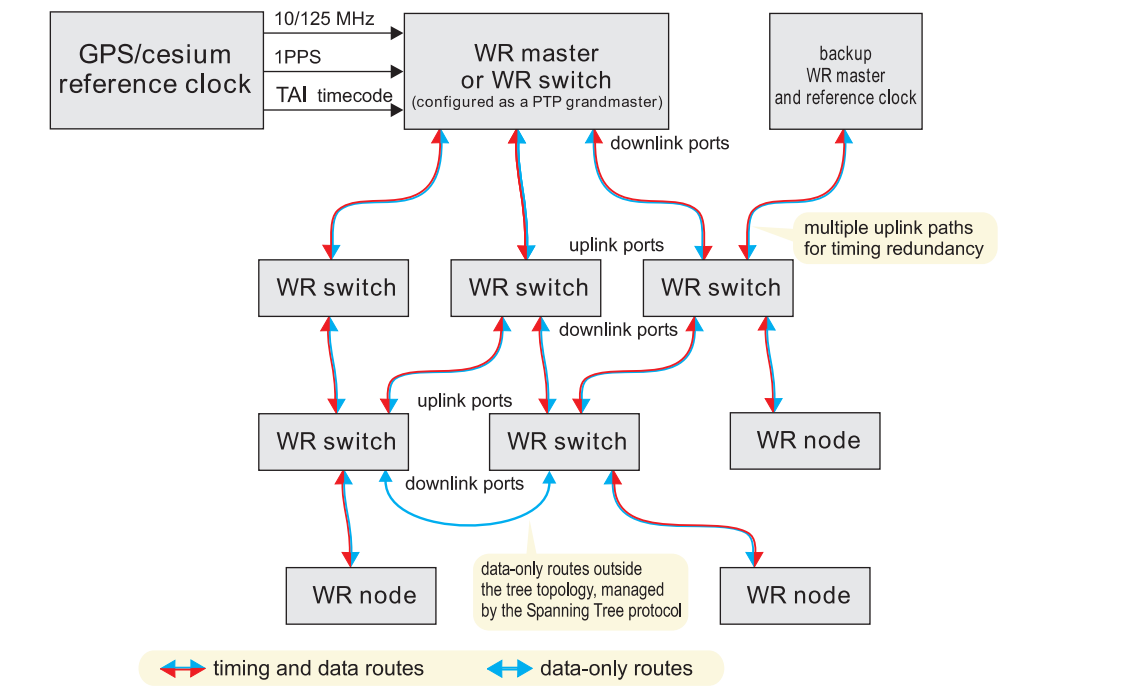
    Abstract White Rabbit (WR) is a multi-laboratory, multicompany collaboration for the development of a new Ethernet-based technology which ensures sub-nanosecond synchronisation and deterministic data transfer. The project uses an open source paradigm for the development of its hardware, gateware and software components. This article provides an introduction to the technical choices and an explanation of

    Explore →