
Documents
-

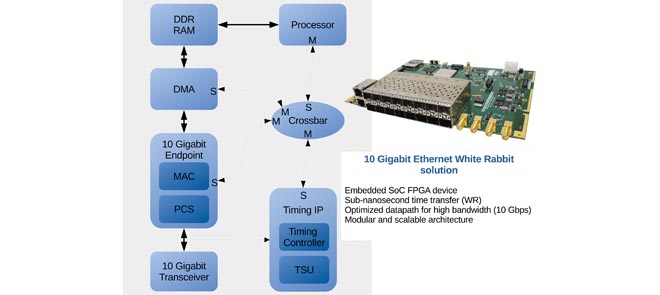
10 Gigabit White Rabbit: Sub-Nanosecond Timing and Data Distribution
Abstract Time synchronization is a critical feature for many scientific facilities and industrial infrastructures. The required performance is progressively increasing everyday, for instance, few tens of nanoseconds for Fifth Generation (5G) networks or sub-nanosecond accuracy on next family of particle accelerators and astrophysics telescopes. Due to this exigent accuracy, many applications require specific timing dedicated
-

A reliable White Rabbit Network for the FAIR General Timing Machine
Abstract A new timing system based on White Rabbit (WR) is being developed for the upcoming FAIR facility at GSI in collaboration with CERN and other partners. The General Timing Machine (GTM) is responsible for the synchronization of nodes and distribution of timing events, which allows the real-time control of the accelerator equipment. WR is
-
A Time Stamping TDC for SPEC and ZEN Platforms Based on White Rabbit
Abstract Sub-nsec precision time synchronization is requested for data-acquisition components distributed over up to tens of km2 in modern astroparticle experiments, like upcoming Gamma-Ray and Cosmic-Ray detector arrays, to ensure optimal triggering, pattern recognition and background rejection. The White-Rabbit (WR) standard for precision time and frequency transfer is well suited for this purpose. We present
-
A White Rabbit setup for sub-nsec synchronization, timestamping and time calibration in large scale astroparticle physics experiments
Abstract Time synchronization with nanosecond precision between individual detectors, distributed over km-scale, is a typical challenge for large astroparticle physics experiments. We adapt the new White Rabbit technology, an Ethernet extension for synchronization, precision time and frequency transfer, to build a prototype system for trigger-time stamping and test-pulse injection for a distributed data acquisition environment.
-

Cookbook and Guidelines for White Rabbit Infrastructure at CERN
Abstract This document provides basic introduction to White Rabbit (WR) and sets uniform guidelines for installationand configuration of White Rabbit Networks for different applications, as well as guidelines on how all theseWR Networks should be interconnected. This includes guidelines for WR Switch naming, VLANsconfiguration, IP assignment, diagnostics and monitoring. MORE ABOUT THIS TOPIC Related Publications
-
Development of a White Rabbit Interface for Synchronous Data Acquisition and Timing Control
Abstract Sub-nanosecond precision timing distribution and control are key techniques in various distributed real-time applications, where the proposed White Rabbit (WR) project provides a solution combining both data transmission and timing control via the same media. This paper demonstrates the design and development of a compact, standalone WR node following FPGA Mezzanine Card (FMC) standard,
-
Digital dual mixer time difference for sub-nanosecond time synchronization in Ethernet
Abstract A digital architecture for the Dual Mixer Time Difference (DMTD) is presented. This architecture has several advantages over other phase frequency detectors such as being linear, not having a dead zone and with an accuracy within the sub-picoseconds range. The intrinsic phase noise present in all timing signals is the main cause of the
-
Digital femtosecond time difference circuit for CERN’s timing system
Abstract This paper presents a novel digital circuit, based on the analog Dual Mixer Time Difference circuit, developed by David W. Allan, designed to characterise oscillators frequency stability. The proposed digital circuit, named Digital Dual Mixer Time Difference (DDMTD), is capable of measuring time differences between two digital clock signals with very fine resolution (subpicosecond)
-
Discussion On A White Rabbit based CERN Control and Timing Network
Abstract This document was created to summarize a week-long brainstorming and discussion on how a new CERN Control andTiming Network based on the White Rabbit technology could look like. MORE ABOUT THIS TOPIC Related Publications Are you looking for a paper in particular?
-
Distributed DDS in a White Rabbit Network: An IEEE 1588 Application
Abstract Direct Digital frequency Synthesizers (DDS) require a reference local oscillator (LO) to synthesize waveforms with various frequencies. The output clock inherits to a certain degree the frequency stability of the LO. However, very stable clocks, as those generated from atomic standards, employ a prohibitive price to have as LO. In this paper, a system